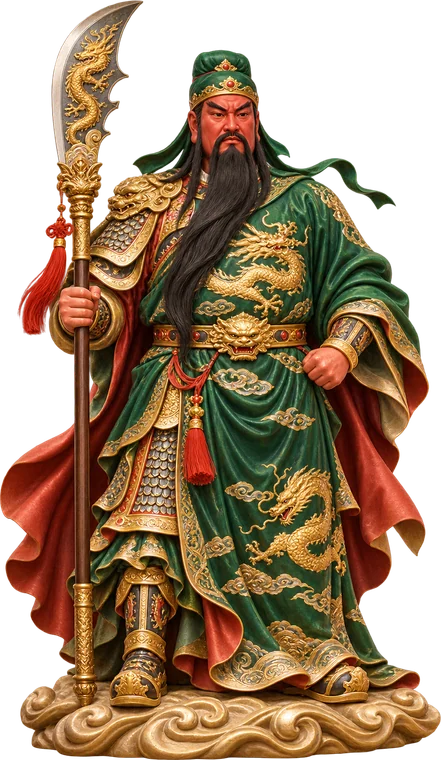
Holy Emperor Guan
Guan Di
Also known as Guan Gong, Lord Guan, Sangharama Bodhisattva
A general of the Three Kingdoms famed for loyalty and honour, later revered as a protector of the upright.
Who this is
Guan Di was a real man: Guan Yu, a general who served Liu Bei at the end of the Han dynasty and died in the year 220.
He was remembered for keeping his word. Later dynasties raised his rank again and again, from marquis to king to emperor.
Confucians honour him as Master Guan, Buddhists as a guardian of monasteries, Taoists as Holy Emperor Guan. Merchants, who prize a man of his word, also keep him as a god of wealth.
He is shown with a red face and a long black beard, in a green robe, his crescent blade at his side.
What people ask for
- Protection from harm
- Honest and thriving business
- Fair treatment when wronged
- Guidance, through the fortune sticks, on a hard decision
Feast days
- 24th day of the 6th lunar month
- His feast day, as most temples keep it
- 13th day of the 5th lunar month
- Kept by some temples instead
Paying respects
- Three joss sticks, three bows.
- Before drawing a stick, say your name and your question silently; afterwards, toss the moon blocks to confirm it.
- Keep whatever you promise in front of him. Good faith is what he stands for.
In Singapore
Guan Di is enshrined in many temples here, and on the altars of shops and clan associations, as a reminder of good faith in dealings.
Accounts and customs differ between temples and communities. These are the most widely told versions, offered for understanding only.