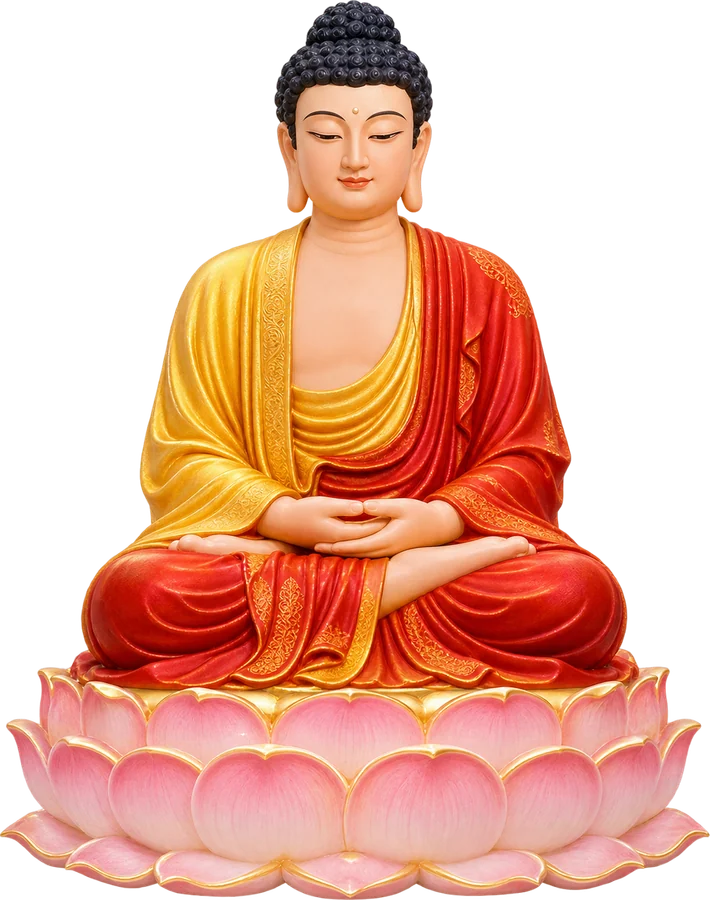
The historical Buddha
Sakyamuni Buddha
Also known as The Buddha, Gautama Buddha, the World-Honoured One
The founder of Buddhism: an awakened teacher, not a god who grants wishes.
Who this is
He was born Siddhartha Gautama about 2,500 years ago at Lumbini, in what is now Nepal, a prince of the Sakya clan.
At 29 he left the palace. At 35 he awakened beneath the Bodhi tree at Bodh Gaya. He taught for 45 years and passed away at 80 in Kushinagar.
He taught where suffering comes from and a way out of it: the Four Noble Truths and the Noble Eightfold Path.
The main hall of a Chinese monastery is the Mahavira Hall, 大雄宝殿. “Great Hero” is a title of the Buddha.
Why people bow
- To show respect and gratitude
- To remind themselves to practise what he taught
- To set pride down and let the mind settle
- A bow is not a bargain: wishes are fulfilled by one's own actions
Feast days
- Vesak Day (usually the 15th of the 4th lunar month)
- Marks his birth, awakening and passing; a public holiday in Singapore
- 8th day of the 4th lunar month
- The Buddha's birthday in the Chinese tradition, when monasteries bathe an image of the infant Buddha
- 8th day of the 12th lunar month
- The day of his awakening, known as Laba
Paying respects
- Join your palms, bow from the waist, or make three full bows.
- Offer flowers, lamps, clear water and fruit. Nothing with meat.
- Joss paper is not burned in a Buddhist monastery.
- Dress neatly and keep quiet inside the hall.
In Singapore
On the eve of Vesak, devotees at Kong Meng San Phor Kark See Monastery circle the grounds through the night, bowing every three steps.
Singapore's Buddhists follow Chinese Mahayana, Theravada and Tibetan traditions. Vesak is the day they share.
Accounts and customs differ between temples and communities. These are the most widely told versions, offered for understanding only.